The production process creates a dataset of intent, alternatives, choices, revisions and consequences.
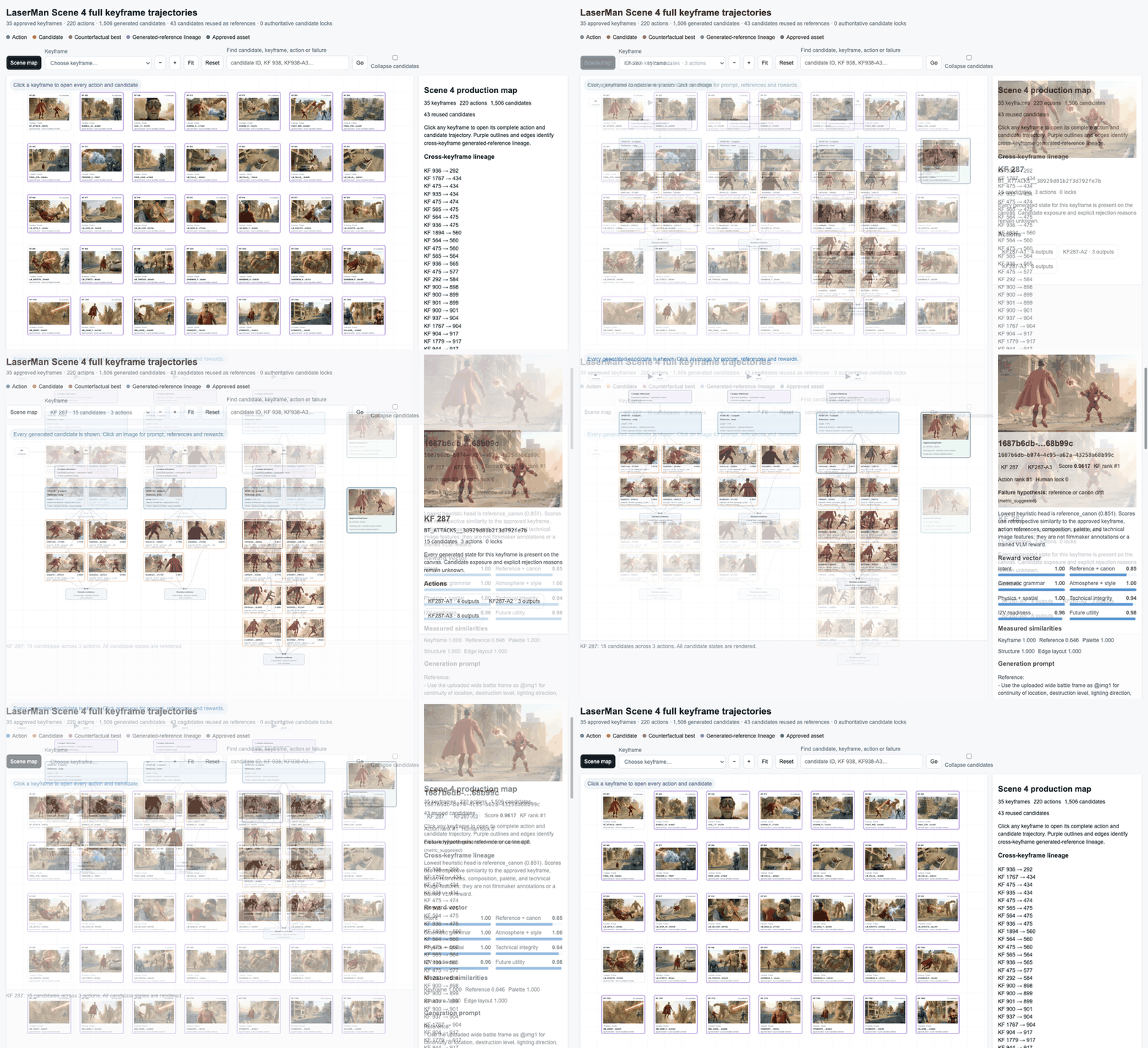
Production archive
The research begins inside production.
SF Locale began using generative models in January 2026. The studio has completed five feature-length films since then.
Each record can connect a shot's intent, prompt, references, candidate family, director choice, revision reason and final position in sequence.
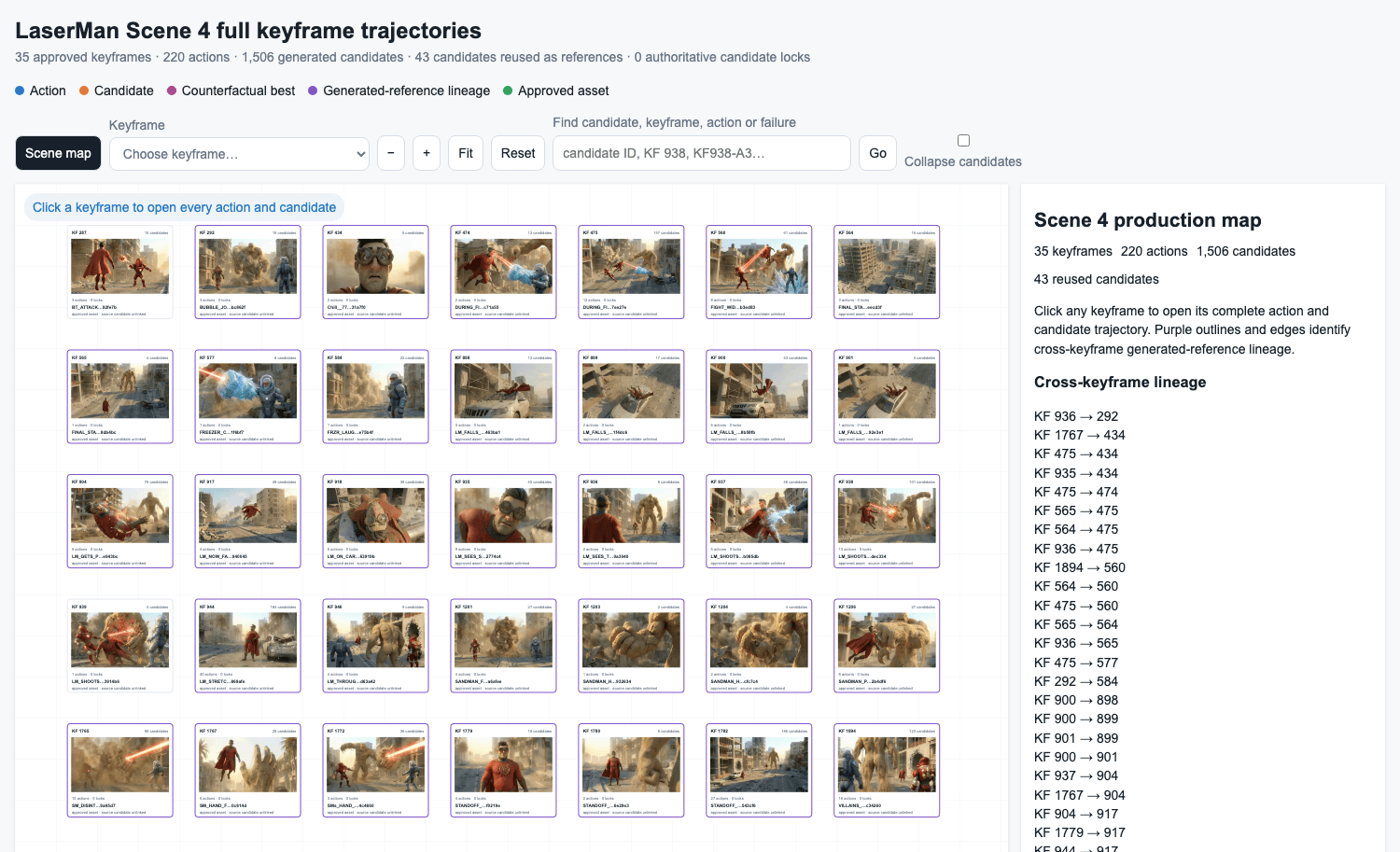
Research object
The trajectory is the learning object.
A finished shot contains only the result. The production trajectory preserves the alternatives that were considered, the actions that produced them and the judgment that moved the film forward.
The archive is being reconstructed as a branching decision graph. A route can be locked, revised, retained for later use or terminated. A selected image can also become a reference for a later shot.
τₜ = (Xₜ, Aₜ, Oₜ, Hₜ, Fₜ, Xₜ₊₁, Gₜ, Cₜ, Yₜ)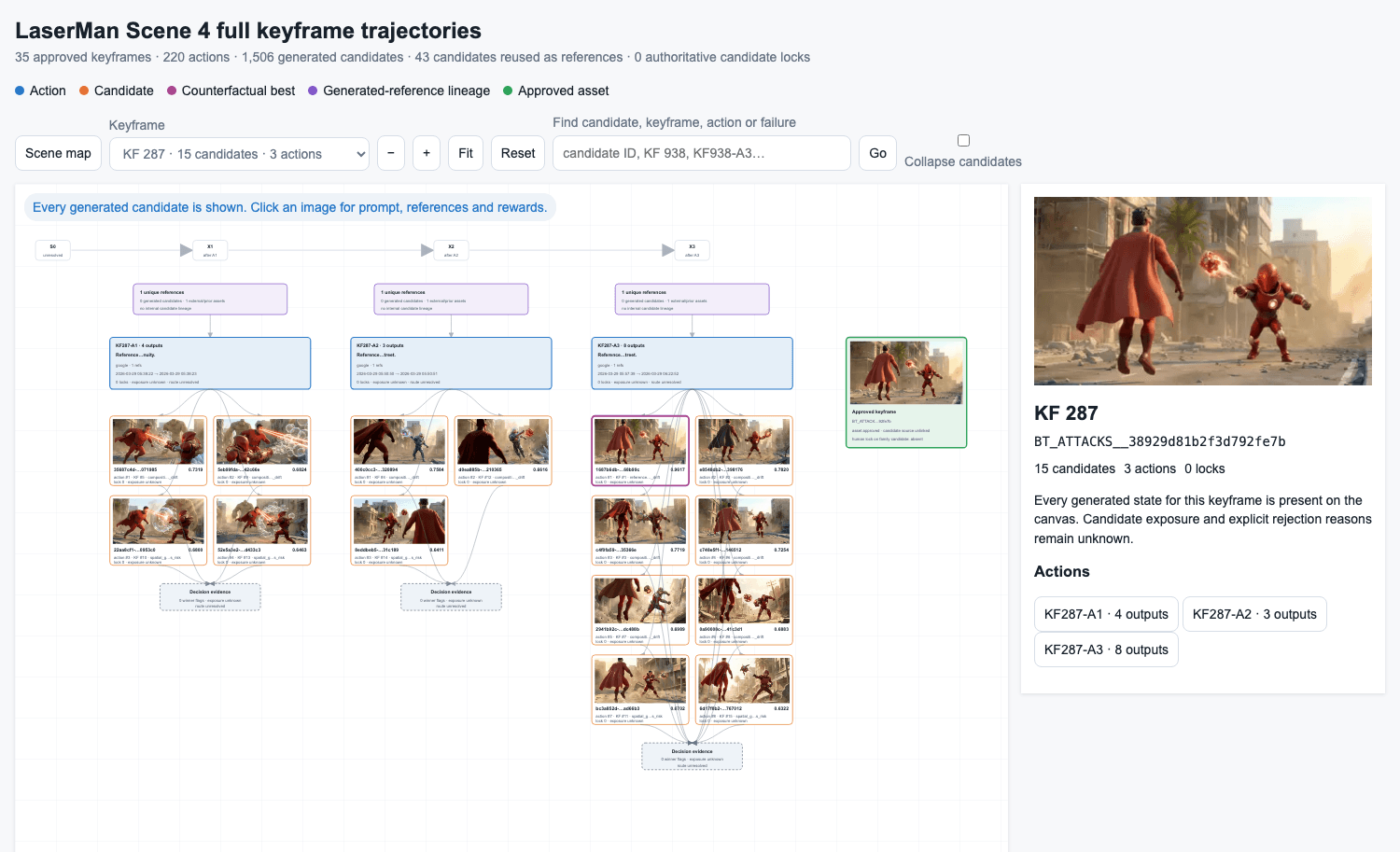
State representation
The model needs the state of the film.
A prompt does not describe everything that makes a candidate useful. The same image can be correct in one sequence and unusable in another. A useful representation needs the context that shaped the decision.
- Active canon
- The committed facts of the film, including character identity, location, wardrobe, props, time and visual rules.
- Lineage
- The parent candidates, references, branches and workflow operations that produced the current state.
- Human history
- The locks, shortlists, rejections, revisions, retained branches and prior reasons around the shot.
- Shot objective
- The narrative purpose, desired performance, framing, movement and relation to surrounding shots.
- Production pressure
- The time, compute, budget and delivery constraints active when the decision was made.
First benchmark
The first experiment tests whether context improves prediction.
The first benchmark can compare a simple critic that sees a candidate and prompt with a contextual critic that also sees canon, references, lineage and earlier decisions. Both models predict the filmmaker's recorded choice.
Production context and trajectory history should improve the prediction of filmmaker choices, repairs and stopping decisions.
The evaluation can measure pairwise accuracy, top-k lock recall, ranking quality, calibration, abstention, next-action accuracy and repair-cost prediction. Performance should be reported over time and across held-out films.
Reward model
Human judgment has several dimensions.
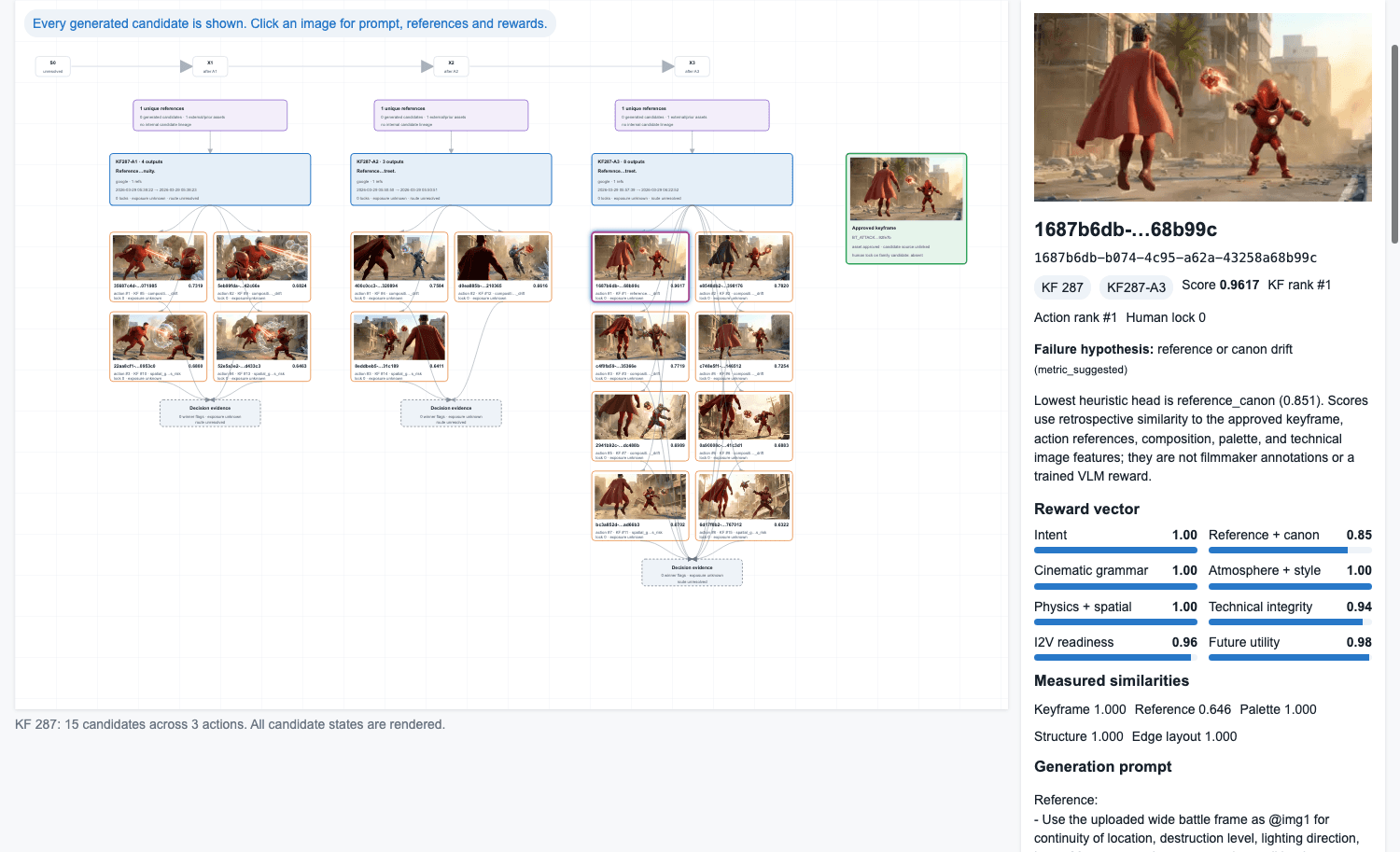
A lock means that a candidate was selected for a specific role in a specific production state. It does not mean that the candidate is universally good. An unselected candidate may become useful later, and an unseen candidate provides no preference evidence.
A critic can keep separate estimates for intent, reference fidelity, canon consistency, performance, cinematography, technical quality, narrative function and production utility. The weight of each estimate can change with the production state.
Q(Sₜ, s) = immediate fit + future utility − expected repair costResearch note. The archive does not yet establish a calibrated value function or a causal measure of future repair cost.
Learning problems
The archive supports several learning problems.
Selection
Rank candidates for the current shot and explain which constraints drive the ranking.
Orchestration
Predict the next production action, including revision, model choice, workflow operation and branch change.
Reference policy
Choose which prior images, characters, locations and style references should condition the next action.
Stopping
Estimate when a route is ready to lock and when further generation has low expected value.
Continuity
Predict when a local choice will create later repairs or reduce creative options elsewhere in the film.
Scene policy
Coordinate shot scale, composition, movement, duration and order across a complete scene.
Research program
The research proceeds from measurement to assistance.
The current program treats existing generators as components of the production environment. The immediate work is to make the trajectory auditable and establish reliable baselines.
Current status. The archive and system definitions exist. Model training and validation remain open research work. The page makes no claim that a production reward model, orchestration policy or debt model has been trained.
Research practice
The studio funds research through film production.
SF Locale is a studio of filmmakers and engineers from IIT Bombay and IIT BHU. The studio makes films for clients and for its own projects. Production funds the research and continues to grow the trajectory archive.